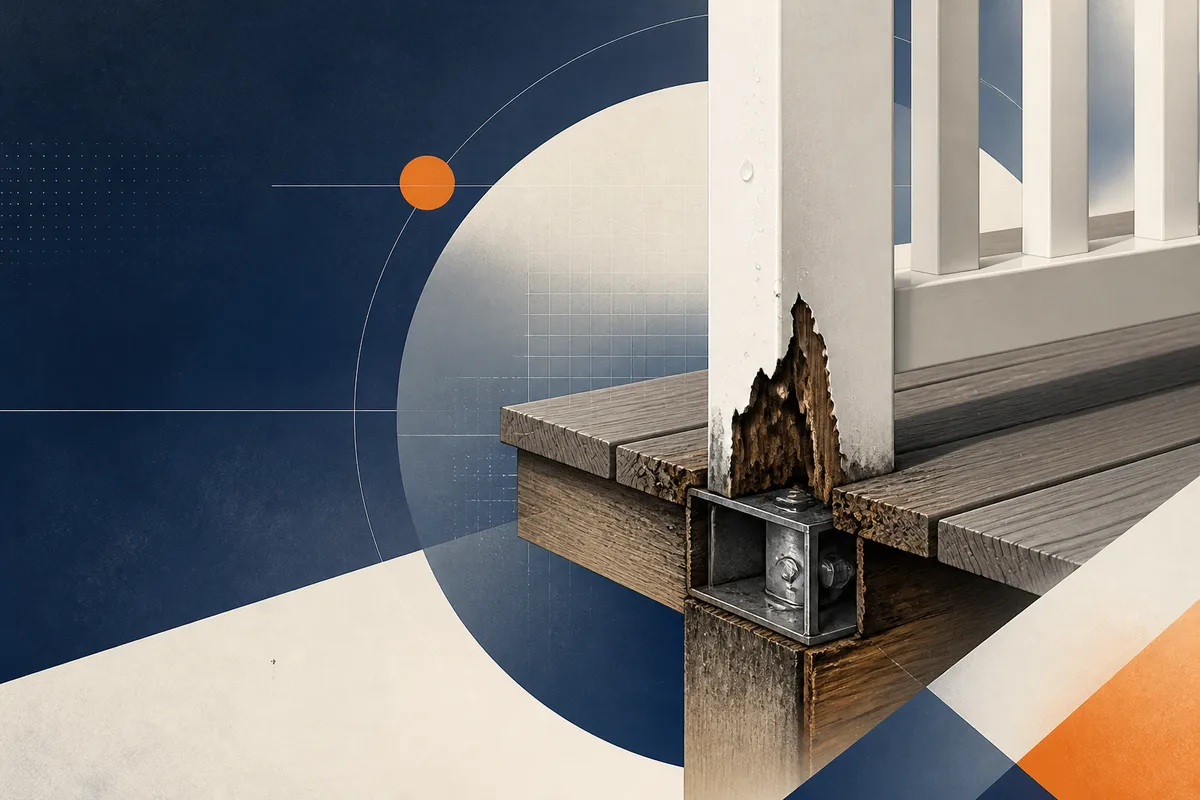
The Physics of Post Rot: Why Deck Railings Fail at the Base
Most deck railing failures are not caused by structural overload, but by invisible decay at the primary connection point. In a humid climate, water sits in the micro-gaps between a metal mounting bracket and a wooden post, creating a permanent moisture sandwich. Once the protective coating of the wood is pierced by a lag bolt, moisture travels directly into the thirsty internal fibers, leading to soft-rot that can compromise the railing's safety long before the damage is visible on the exterior.
This guide breaks down the mechanics of moisture intrusion and the technical methods used to prevent deck railing post rot. It is intended for homeowners and property managers who are evaluating the longevity of their porch and step railings and want to understand why traditional mounting methods often fail prematurely.
Why Conventional Railing Mounts Fail
Water behaves predictably, following gravity and capillary suction into the tightest available spaces. When a railing is installed without regard for these forces, several points of failure emerge:
- Surface tension holds water between the post base and the decking, preventing the wood from ever fully drying out after a rain.
- Unsealed fastener holes act as straw-like conduits, pulling rainwater deep into the heartwood of the post or the stair stringer.
- Lack of airflow around the mounting hardware creates a micro-environment where wood-decay fungi thrive.
- Fluctuating humidity levels cause the wood to expand and contract, eventually loosening the grip of the fasteners and widening the entry points for moisture.
The Technical Framework for Waterproof Railing Anchors
Preventing decay requires a shift from "sealing water out" to "managing water's exit." A durable installation follows a specific sequence to ensure no moisture remains trapped against structural timber.
1Seal the End Grain
The bottom of a wooden post is essentially a bundle of open tubes. Applying copper caps or high-quality sealants help shield hardware and unprotected cut ends against the elements restorelogs.com. This treatment helps prevent moisture from entering the end grain decks.com.
2Utilize Stand-off Brackets
Mounting a post directly flush to a deck surface is a recipe for rot. Using specialized waterproof railing anchors that incorporate a built-in stand-off allows air to circulate under the post and water to flow away freely.
3Implement Advanced Flashing Techniques
For posts that are side-mounted to the joists or stringers, deck post flashing techniques are mandatory. This involves using metal or vinyl flashing to keep water out where the deck connects to the home or where hardware meets wood facebook.com. Using a rubber sleeve is another effective method to prevent future rot and ensure long-term stability decksgo.com.
4Direct Fastener Protection
Every screw or lag bolt represents a breach in the wood's natural defense. Waterproofing the exact wood fibers that hold the hardware protects the connection and carries the load ultramodernrails.com.
The Stair Stringer Vulnerability
Stair railings face a unique challenge because Interior Stair Railings and exterior deck stair stringer protection are often overlooked. Because stringers are cut into a "sawtooth" pattern, they expose a massive amount of end grain. When a railing post is bolted to the side of a stringer, water often collects in the notch where the post meets the wood.
Technical mitigation involves "over-flashing" these intersections. Protective coatings and membranes should be applied over the top of the cut stringer before the tread is installed. This prevents the "picket-fence effect," where every vertical post acts as a funnel for water to travel into the stairs' main structural support.
How Nashville Stair Railing Helps
Addressing structural decay requires a thorough inspection of the existing wood integrity. A typical project involves shoring up the deck for safe post removal and replacing the rotted-out posts youtube.com. This often necessitates a railing repair to replace compromised structural members. Homeowners should expect a detailed plan that outlines how water will be diverted from new connection points. Those ready to address safety concerns in the Nashville area can reach the team at (615) 437-4214 to discuss their specific site requirements.
For projects involving new construction or significant structural changes, note that Nashville building permits are generally required for decks and their associated framing to ensure safety standards are met. Providing photos of the current railing's base and the underside of the deck can help expedite the initial assessment process.
Frequently asked questions
How do I know if my deck railing posts are already rotting?
Check the base of the post by probing the wood with a flathead screwdriver; if the wood feels soft or the screwdriver sinks in easily, the structural integrity is compromised. Look for dark staining or fungal growth around the fasteners, which indicates long-term moisture retention. If the railing wobbles even slightly when pushed, the wood fibers around the anchor bolts have likely decayed.
Can I just caulk around the base of my railing posts to stop rot?
Caulking around a post base is often counterproductive because it can trap moisture inside the joint while preventing evaporation. If the seal develops even a microscopic crack, water will enter and stay locked against the wood. It is better to leave the base open for airflow or use a dedicated stand-off bracket.
What are the best materials for a rot-resistant railing?
In the Nashville service area, pressure-treated lumber rated for ground contact is a standard baseline, but it still requires proper flashing. For maximum longevity, many homeowners transition to aluminum or composite systems that do not rely on wood-to-wood contact at the primary stress points.
Is it necessary to replace the whole deck if the railing posts are rot-damaged?
Not necessarily, but the adjacent framing must be inspected. If the rot is confined to the railing post, the solution is to jack up the deck and replace the rotted posts decksgo.com. However, if the decay has spread into the rim joist or the stair stringers, those structural components must be replaced to ensure the new railing is secure.
How often should I re-seal the base of my railing posts?
If using a topical water repellent, it should generally be reapplied every two to three years depending on sun exposure. However, if the posts were installed using proper flashing and stand-off techniques, the internal connection points should not require regular maintenance beyond standard cleaning and inspecting the fasteners for tightness.
Why do my stair railing posts seem to rot faster than my deck posts?
Stair posts are subject to more vibration and movement from foot traffic, which can break the seal of even the best paint or stain. Additionally, the geometry of a stair stringer creates more areas for water to pool compared to the flat surface of a deck, making high-quality flashing essential for stairs.
What happens when you get in touch: you describe the situation, we ask the few questions that actually change the answer, and you get a clear scope and next step — no obligation.