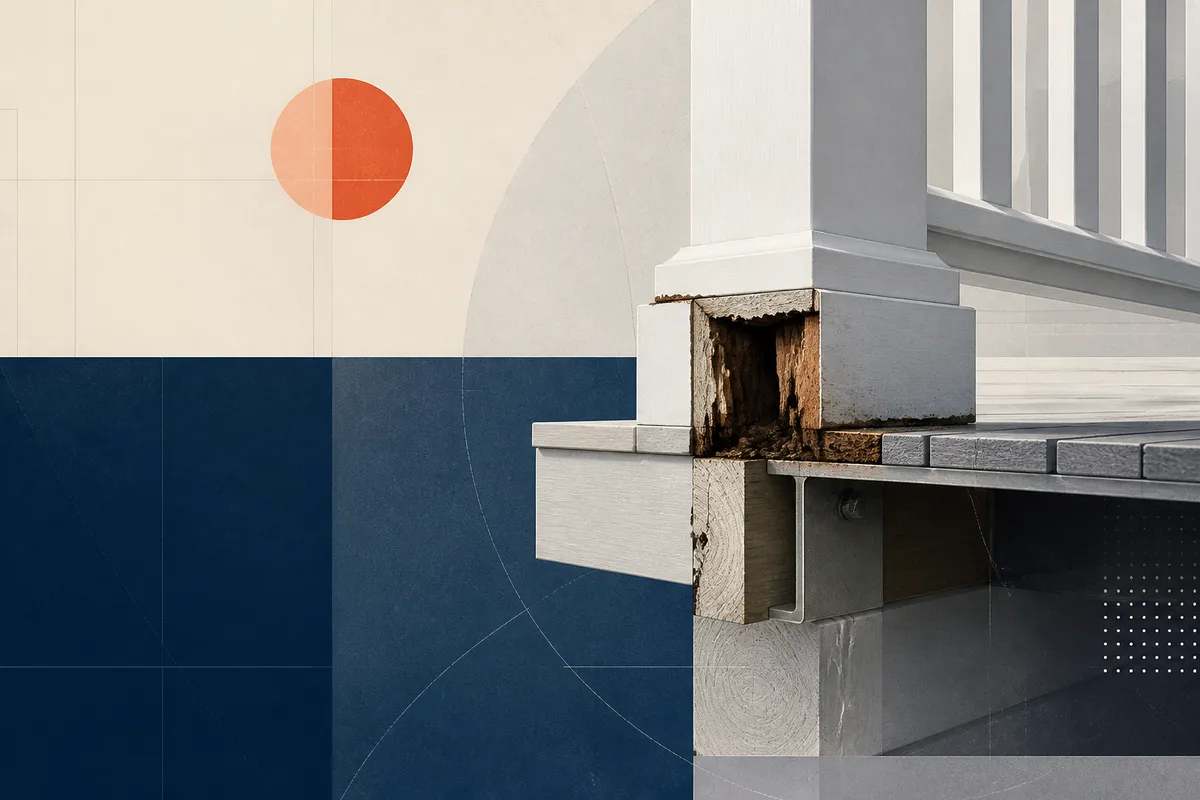
Why Porch Railing Posts Fail: The Technical Reality of Under-Mount Rot
Wooden porch railing posts fail at the base because they are often installed as sponges rather than structural members. When a post is set directly onto a concrete pad or wood decking without a standoff base, it creates a high-moisture "dead zone" where water is trapped by surface tension. In the Nashville service area, environmental conditions turn these installation gaps into incubation chambers for fungal decay.
This guide outlines the mechanics of under-mount rot and provides a technical framework for preventing wood rot in porch posts before they become a liability. It is intended for homeowners managing properties in humid transition zones who need to distinguish between cosmetic surface wear and terminal structural failure.
The Mechanics of Moisture Trapping under Railing Posts
Post failure is rarely the result of a single storm; it occurs because moisture enters the wood faster than it can escape. In Middle Tennessee, high humidity levels significantly slow the evaporation rate of water trapped in tight joints.
- Capillary action pulls ground moisture upward into the vertical cells of the wood, known as the end-grain.
- Pressure-treated chemicals often fail to penetrate the dense center of a 4x4 or 6x6 post, leaving the heartwood vulnerable.
- Decorative base collars or "trim skirts" act as umbrellas in reverse, holding debris and moisture against the wood rather than shedding it.
- Paint or solid stains applied over damp wood seal the moisture in, accelerating decay as fungus feeds on wood with moisture and oxygen.
The Diagnostic Playbook for Exterior Railings
1Perform the "Pick Test" at the transition
Take a flat-head screwdriver and press it firmly into the wood exactly where it meets the floor. If the tool penetrates the wood easily with moderate pressure, the cellular integrity of the post has failed. Healthy wood should resist the probe with a sharp "thud" rather than a soft "crunch."
2Inspect the end-grain sealing
Check if the bottom of the post was cut at the job site without being re-treated. Installers often trim posts to length, exposing raw, untreated wood at the most vulnerable point. If the base of the post looks darker or more swollen than the top, it is likely absorbing water through an unsealed cut.
3Evaluate the drainage solution
Identify if there is a physical gap between the wood and the masonry. Professional installations generally utilize a galvanized or stainless steel standoff base that provides adequate airflow under and around the posts. If the wood is in direct contact with concrete, rot is a high risk.
4Check for "Invisible" movement
Grasp the railing at the mid-point and apply lateral pressure. If the post base shifts or "cracks" slightly while the top remains steady, the hardware may be worn or the surrounding wood may have decayed. This is a critical indicator that the railing no longer meets safety requirements.
Why End-Grain Sealing for Exterior Wood Fails
Standard wood finishes are designed for the faces of a board, not the porous ends. Think of wood as a bundle of microscopic straws; the end-grain is the open mouth of those straws. When a post sits in standing water—which happens every time it rains on a flat porch—it sucks water up the shaft.
Even pressure-treated wood has limits. If the chemical infusion didn't reach the core, the interior of the post can rot away while the exterior shell looks perfectly fine. This is why "surface-level" repairs like wood filler or epoxy are usually temporary fixes. They do not address the source of the moisture or the hollowed-out core of the structural member.
How Nashville Stair Railing helps
Addressing a failing porch system typically requires a systematic assessment of the existing attachment points and the underlying framing. A standard Railing Repair scope involves removing decorative trim to expose the true condition of the timber and identifying the cause of the loose railing. For homeowners in Middle Tennessee, the process begins with a physical inspection to ensure the system meets safety standards. When a porch addition is planned for a single-family home, owners should be aware that the Nashville.gov building permit process is a required step for new structural work.
More detail on the work itself: Nashville Service Area.
Frequently asked questions
Can I save a post that has already started to rot at the bottom?
If the decay has significantly affected the wood, the structural integrity is compromised and the post should be replaced. While some cosmetic repairs use wood hardeners, knowing when replacement is the safer option is vital for residential safety.
Why does concrete contact cause wood to rot so fast?
Concrete is porous and acts as a reservoir that holds moisture long after the rain stops. When wood sits on concrete, it stays saturated, providing the moisture necessary for microbes and fungus to consume the wood fibers.
Is pressure-treated wood immune to under-mount rot?
No, pressure treatment is a deterrent, not a cure. Over time, the chemicals can leach out, and if the post was cut during installation without the end-grain being re-treated, it will remain vulnerable to decay at the cut point.
How often should I inspect my porch railings?
Given the local climate, a thorough physical inspection should be performed twice a year—once in the spring and once in the late fall. Look specifically for localized discoloration and any signs of fungal growth at the base of the posts.
What is the best way to prevent rot on a new installation?
The most effective method is using a proper concrete footing with a standoff base that prevents the wood from touching the ground. This setup ensures adequate airflow so the wood can dry out completely.
Does painting the bottom of the post help?
Painting the bottom of a post before it is installed can provide a temporary moisture barrier, but if water gets behind the paint, it will actually accelerate the rot. Providing a drainage gap is significantly more effective than paint alone.
What happens when you get in touch: you describe the situation, we ask the few questions that actually change the answer, and you get a clear scope and next step — no obligation.